
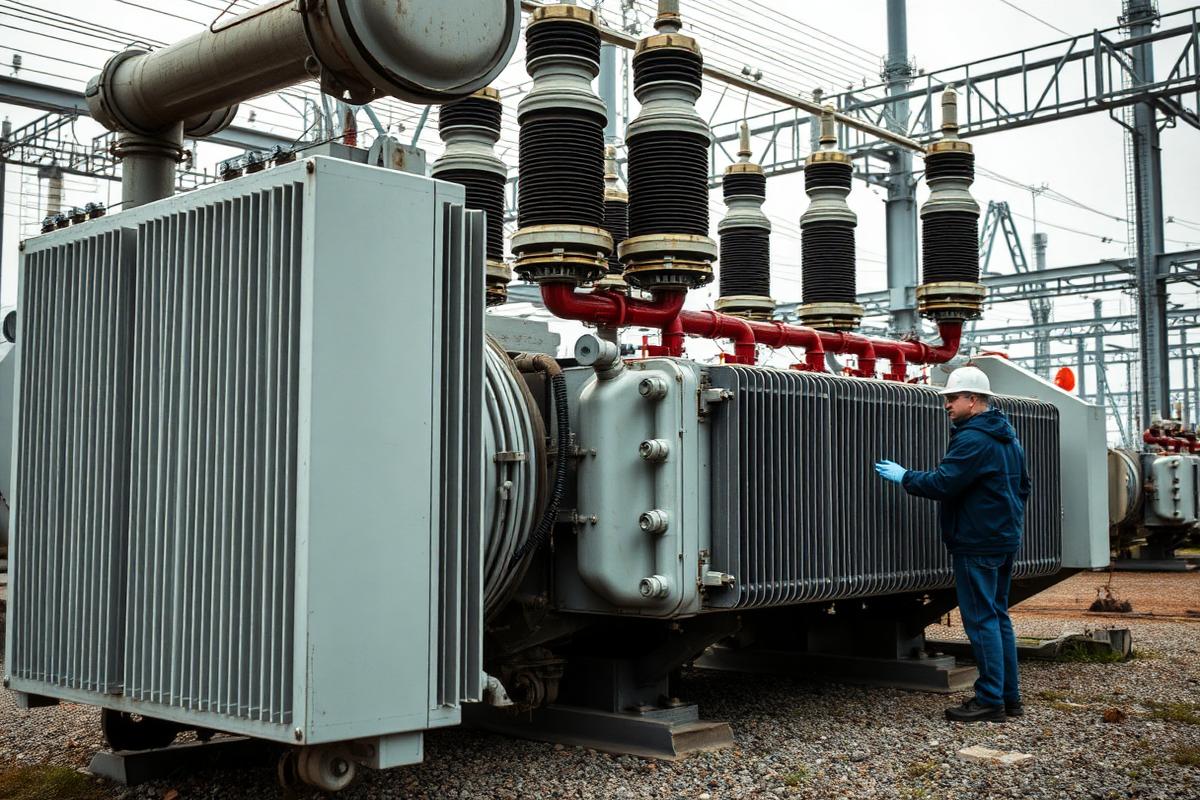
An 8 MVA 11/3.3 kV unit failed at a client's site on a Sunday morning, took out half the plant for nine days and cost somewhere north of twelve million rand once lost production was counted. The post-mortem took an afternoon. Their oil sample results going back three years were in a folder on the shared drive. Acetylene had appeared eighteen months earlier and climbed steadily.
Nobody had plotted it. The lab report had a summary line, someone filed it, and the next sample was taken a year later.
Dissolved gas analysis works, if you trend it
DGA is close to a solved problem technically. IEC 60599 and IEEE C57.104 give you interpretation frameworks, and the diagnostic ratios — Rogers, Duval's triangle — have been reliable for decades.
The failure is procedural. A single result tells you very little; a rate of change tells you almost everything. Acetylene at 4 ppm on one sample is a note. Acetylene going from 0 to 4 to 19 ppm over nine months is an active arcing fault and the unit needs to come out.
Practical rules I apply:
- Annual sampling as a minimum for units above 1 MVA; six-monthly for critical or ageing units; immediately after any through-fault or unusual operation
- Same laboratory, same sampling technique, same sampling point — comparability matters more than absolute accuracy
- Results plotted on a running chart, not filed as PDFs. A spreadsheet is sufficient. The absence of a chart is the actual root cause in most cases I investigate
- Any acetylene at all on a unit that previously had none triggers a resample within a month
Moisture is the slow killer
Arcing gets attention because it is dramatic. Moisture in the paper insulation does more cumulative damage and gets ignored because nothing happens quickly.
Water accelerates cellulose degradation roughly proportionally with content, and the paper is what actually determines transformer life — the oil can be replaced, the winding insulation cannot. Furan analysis gives you an indication of paper condition and it is worth running on any unit over twenty years old that you intend to keep.
Breathers are the cheapest intervention in the entire asset class and the most neglected. Silica gel that has gone pink on every transformer in a yard tells you something about the maintenance regime that no amount of dashboard reporting will.
Bushings and tap changers
Split the failure statistics and the winding is not the leading cause. Bushings and on-load tap changers account for a large share of serious events.
Bushings fail through moisture ingress and partial discharge, and capacitance and tan delta testing at defined intervals catches the deterioration. Thermographic survey under load catches connection problems that no offline test will.
Tap changers are mechanical devices operating thousands of times, in oil, largely unobserved. They need maintenance on an operations count basis, not a calendar basis, and separate oil sampling of the diverter compartment — mixing that sample with main tank oil produces a diagnosis that is simply wrong.
The pump parallel
The same pattern shows up on rotating equipment. Process pump failures are dominated by seals and bearings, and the majority of those trace back to installation and operating conditions rather than component quality — misalignment, pipe strain, running well off the best efficiency point, or a duty-standby arrangement where the standby is started once a quarter and has been sitting with a dry seal face.
Cavitation is the one that gets miscoded most often. Recurrent impeller damage is a system problem: suction line design, NPSH available, a strainer nobody cleans. Replacing the impeller a fourth time is not maintenance, it is subsidising a design fault.
What to do on Monday
Pull the last three years of oil results for your ten most critical transformers and plot the gases. It is an afternoon of work. In roughly a third of the sites where I have done it, something on that chart needed attention that nobody had noticed.
Then decide who owns the trend — a named person who looks at it, not a folder. Condition monitoring data that nobody interprets is an expense, not a control.